
What makes the Oregon school shooting different
Clip: 10/16/2026 | 4m 58sVideo has Closed Captions
What makes the Oregon school shooting different – and what can be learned
There are many more questions to be answered about the deadly elementary school shooting in Bend, Oregon. To explore some of them, Amna Nawaz spoke with James Densley, professor and chair of criminology and criminal justice at Metro State University. He is best known for co-creating the Violence Prevention Project, a database of mass shooters in the United States.
Problems playing video? | Closed Captioning Feedback
Problems playing video? | Closed Captioning Feedback
Major corporate funding for the PBS News Hour is provided by BDO, BNSF, Consumer Cellular, American Cruise Lines, and Raymond James. Funding for the PBS NewsHour Weekend is provided by...
What makes the Oregon school shooting different
Clip: 10/16/2026 | 4m 58sVideo has Closed Captions
There are many more questions to be answered about the deadly elementary school shooting in Bend, Oregon. To explore some of them, Amna Nawaz spoke with James Densley, professor and chair of criminology and criminal justice at Metro State University. He is best known for co-creating the Violence Prevention Project, a database of mass shooters in the United States.
Problems playing video? | Closed Captioning Feedback
Where to Watch PBS News Hour
PBS News Hour is available to stream on pbs.org and the PBS app.
Providing Support for PBS.org
Learn Moreabout PBS online sponsorshipAMNA NAWAZ: There are many more questions to be answered in the days ahead.
To explore some of them, we're joined now by James Densley.
He's professor and chair of criminology and criminal justice at Metro State University in Minnesota.
He's best known for co-creating The Violence Prevention Project.
That is the largest, most comprehensive database of mass shootings in the United States.
Welcome and thanks for being with us.
So, some limited information about the shooter and the way this attack unfolded so far.
But, from what we do know, what stands out to you about this shooting?
JAMES DENSLEY, Co-Founder and President, The Violence Project: There are several things.
We have 26 years of school homicides in our database, nearly 400 cases.
And this is the first time a civilian shot and stopped the attacker.
Usually, when school shootings are stopped before the police arrive, it's by a teacher, a coach, a custodian, or another student who tackles the shooter before they reload.
So that's a very unique thing.
You know, we have a father here with two daughters at the school.
He ran toward the gunfire.
It's incredible bravery.
And I'm sure it'll be held up as proof of one argument to another, but we must not forget that this also began with a 16-year-old who got hold of a gun that they should not have had.
And that's the best part of prevention that we have here for the next time.
Even with a hero on the scene, in three minutes, four people were already dead.
So, stopping a shooter is not the same as preventing a shooting.
And so the real goal is to never need these heroes at all.
AMNA NAWAZ: We should also point out the teacher who was involved in the altercation with the shooter apparently threw her cell phone at him and was fighting with him when that father entered the building and ultimately shot him.
But I should also point out what officials shared about the fact that the shooter entered the building by forcing his way, shooting his way through locked doors.
The superintendent today mentioned how much they have invested in security.
How should we look at that, the front-end security that many schools have now put in place?
JAMES DENSLEY: Yes, it's a great question.
The doors were locked and he shot through them.
The locks buy time and time saves lives usually.
But a locked door is also the last line of defense.
It's not the first.
In our data, shooters force their way into schools in only a handful of cases.
Most of those, though, do tend to be former students, because they know the building and they're prepared to break in.
And by the time someone is shooting at your front door, prevention's already failed in many ways.
The real work, I think, has to happen weeks and months earlier, when someone notices warning signs and can step in.
AMNA NAWAZ: Officials also said today they don't yet know how the shooter got the weapon or the ammunition.
It's been reported, however, that the shotgun belonged to his mother.
Is that kind of situation consistent with what we have seen in the past where a minor gets access to a weapon from a parent or relative?
JAMES DENSLEY: Yes, sadly, that's part of the story that's painfully familiar.
In school mass shootings in our data, whenever a shooter is a teenager, and we know where the gun comes from, it usually comes from home every single time, actually.
It's typically parents and grandparents.
Children are too young to buy these guns, and so that's why they take them.
But this is also the most preventable part of the problem.
A lock safe at home costs a few hundred dollars.
It's the cheapest school safety measure in America, and it's the one that's right in your house, not even at the school.
So I would say, for every parent watching this tonight, ask yourself this question.
Could my child access my gun today if he or she wanted to?
And if the answer is yes, then you need to do something about this.
Now, we have seen cases in Oxford, Michigan, and also the Apalachee High School in Georgia where parents have actually been charged and found negligent and guilty for these cases.
So the law is starting to treat these unsecured guns as part of the crime.
AMNA NAWAZ: Got a minute or so here left, but I have to ask you about what we heard from the school superintendent when he said how deeply impacted everyone in the community is and how this will stay with them for years to come.
From the shootings you have looked at in the past, how does it stay with a community?
JAMES DENSLEY: I mean, it's just -- it's every parent and every community's worst nightmare.
I mean, the youngest child killed was just 5 years old in this case.
In our data, no younger child has died in an attack on a school.
And the shooter was 16.
This is children killing children.
It's a tragedy on so many levels, and it will have ripple effects throughout that community for generations.
There's going to need to be a lot of care and compassion and aftercare and support for these families and for this community.
And my heart goes out to them, and I'm sure everybody else who's watching this tonight as well.
It's just devastating.
AMNA NAWAZ: That is Professor James Densley from Metro State University joining us tonight.
Thank you so much.
JAMES DENSLEY: Thank you.
 New
NewCapehart and Continetti on the press secretary's quick exit
Video has Closed Captions
Capehart and Continetti on the White House press secretary's quick exit (9m 18s)
 New
NewExamining Trump's claims at his midterm rallies
Video has Closed Captions
Examining the controversial claims Trump is making at his midterm rallies (6m 48s)
 New
NewExhibition explores link between Black women and Shakespeare
Video has Closed Captions
Exhibition explores connection between Black women and the works of Shakespeare (6m 17s)
 New
NewHow Alaska became a battleground in the fight for the Senate
Video has Closed Captions
How Alaska became a key battleground in the fight for the Senate (5m 1s)
 New
NewKerry Kennedy remembers mother's life, advocacy in new book
Video has Closed Captions
Kerry Kennedy remembers her mother's life and advocacy in new book (8m 49s)
 New
NewNews Wrap: Zacharia out as White House press secretary
Video has Closed Captions
News Wrap: Zacharia out as White House press secretary after less than a week on the job (4m 57s)
 New
NewOregon shooter attacked special ed classroom, police say
Video has Closed Captions
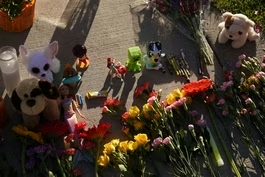
Oregon school shooter attacked special education classroom, police say (4m 32s)
Providing Support for PBS.org
Learn Moreabout PBS online sponsorship New Episode
- News and Public Affairs

Today's top journalists discuss Washington's current political events and public affairs.
 New Episode
- News and Public Affairs

FRONTLINE is investigative journalism that questions, explains and changes our world.
 New Episode
 New Episode
 New Episode
 New Episode


 New Episode


 New Episode
Support for PBS provided by:
Major corporate funding for the PBS News Hour is provided by BDO, BNSF, Consumer Cellular, American Cruise Lines, and Raymond James. Funding for the PBS NewsHour Weekend is provided by...