
Inspector General Deborah Witzburg Reflects on Her Tenure
Clip: 4/16/2026 | 11m 7sVideo has Closed Captions
The city faces scrutiny over the federal consent decree and whether reforms are on track.
As Chicago’s top watchdog prepares to step down, she leaves behind a series of sharp critiques of police oversight and accountability — including new findings that raise concerns about how misconduct is investigated and documented within the Chicago Police Department.
Problems playing video? | Closed Captioning Feedback
Problems playing video? | Closed Captioning Feedback
Chicago Tonight is a local public television program presented by WTTW
WTTW video streaming support provided by members and sponsors.
Inspector General Deborah Witzburg Reflects on Her Tenure
Clip: 4/16/2026 | 11m 7sVideo has Closed Captions
As Chicago’s top watchdog prepares to step down, she leaves behind a series of sharp critiques of police oversight and accountability — including new findings that raise concerns about how misconduct is investigated and documented within the Chicago Police Department.
Problems playing video? | Closed Captioning Feedback
How to Watch Chicago Tonight
Chicago Tonight is available to stream on pbs.org and the free PBS App, available on iPhone, Apple TV, Android TV, Android smartphones, Amazon Fire TV, Amazon Fire Tablet, Roku, Samsung Smart TV, and Vizio.

WTTW News Explains
In this Emmy Award-winning series, WTTW News tackles your questions — big and small — about life in the Chicago area. Our video animations guide you through local government, city history, public utilities and everything in between.Providing Support for PBS.org
Learn Moreabout PBS online sponsorship>> And meet the women powering their own mechanic shop.
First off tonight as Chicago's top watchdog prepares to step down, she leaves behind a series of sharp critiques of police oversight and accountability >> including new findings that raised concerns about how misconduct is investigated and documented within the Chicago Police Department Inspector General Denver, which Berg's departure comes at a pivotal moment as the city faces ongoing scrutiny and of the federal consent decree and questions about whether reforms are on track.
And joining us is Deborah, What's Bird inspector general for the city of Chicago.
Thanks for coming back on the program.
Thanks for having So you've often said Chicago operates at deficit of legitimacy and that a lot of your work was aimed at correcting that imbalance.
How do you the value the progress that you made?
>> This is something I worry about a lot.
you know, the the fact that Chicago earns every bit of its reputation, you know, that has been generations in the making >> and we are not going to fix what's wrong with city government while any one of us is here.
And so in that world where there's no finish line in sight.
Mile markers are hard come by.
And so I've spent a lot of time thinking and worrying about this question of how we know if we are making progress, how we know if it's working.
I think that we have made progress.
I think that we have held people in power to account in a way that historically didn't happen.
And I think that matters to people.
I'm also really encouraged by the fact that get more in takes.
We hear from more Chicagoans more often than the office ever have has before.
So we getting any one quarter we get between 2004 1000 in takes and that number has gone up really consistently over time.
I think that's a good news story.
I don't think that's because more things are going wrong in the city of Chicago.
I think that's because more people know who we are and what we do and where to find us.
And maybe most importantly, I think that more people are willing to believe that if something goes wrong in the city there, someone who will listen and can help.
So.
So I think we've made some progress.
I also think there's a great deal left to do.
>> Well, your time in the inspector general's office that spanned 3 mayoral administrations, Mayor Lori Lightfoot said she wanted an IG who would stand her You've called Mayor Johnson's administration reflects of Lee hostile to oversight.
Do you think that friction was because of those mayor specifically or is it more so a trade among executive executives to resist that oversight?
There is certainly some structural tension between and IG and the entity they oversee.
>> If if in this situation, if the mayor felt entirely warm and fuzzy about the Office of Inspector General, we wouldn't be doing our job.
That said, I think there's a great deal of room for improvement to say the least in the city's cooperation with oversight.
What does that cooperation look like any?
What do you think sort of the?
>> The best case of a working relationship between and I G S office and a Merrill administration.
A city hall should Well, I think.
>> I've given that some thought will say one of the things I'm proudest of about this term is that we have built very productive, very positive working relationships with many people and many departments across city government.
That's not to say that.
Everybody's glad to see us coming or agrees with us.
In fact, so often than not, but we have come to a place with a lot of people in city government where I think there's a shared recognition that if we are not all pulling in generally the same direction, if we are not all working in the direction of building a government that more closely resembles the one Chicagoans deserve that, at least some of us are in the wrong line of work.
And so actually think there are a lot of models for what a good and productive relationship can look like when everybody recognizes the value, albeit sometimes uncomfortable of effective and independent oversight.
>> You mentioned Chicago's not always so great reputation when it comes to corruption.
You said before that the high-profile convictions of folks like former Alderman Ed Burke for House Speaker Michael Madigan, that they should have been a catalyst for systemic reform.
A lot of folks would agree that that hasn't necessarily happened.
think that was a missed chance there.
>> I think that Chicago has historically done a lot of public policy by crisis response.
I think much of what we've seen as we look back over history in the city as we've seen efforts at various kinds of reforms, including police in public safety reform, which have been generated in the wake of a crisis.
I think the release of a local McDonald's video was one of those catalyst events the murder of George Floyd was another again on the public safety front.
And so I think I think some of these catalysts events open this window of opportunity and we certainly have not seized all of those opportunities.
>> You know, you announced that you wouldn't seek a second term after the city Council expanded.
The IG is power in part to block the city's top lawyer from stepping in when their investigations that risked embarrassment or political consequences.
told a city council today the law department has not complied with those new rules.
Are you concerned the mayor might pick a successor who won't as aggressively challenge his administration on that issue and on others.
I think the process for the selection of a new inspector general is one that is fought fully built to guard against the risk to not just this mayor, but any mayor mayor might.
>> Select someone who would who would be sort favorable to them all circumstances.
And so, you know, I believe in the process, I appreciate the folks who've been working on it.
I think we should all all of us who have a stake in a more accountable, more effective government should be watching that process and its outcome closely, as you said, not necessarily a good fit for someone who is a warm and fuzzy relationship with the floor.
>> All right.
Well, let's take a look at some findings from your office's report that came out last week.
In one instance, it says CPD leadership consistently removed police powers when officers were arrested.
But not only not always when they were accused of other serious misconduct.
The CPD doesn't track cases where officers were considered but not ultimately stripped of their police powers also found a black and Latino male officers were disproportionately stripped of police powers.
What do you think CPD needs to do to make things right?
These instances?
>> With the questions around whether and when someone's police powers are removed.
While a misconduct investigation is pending is is part of a really important set of questions that we have looked at around the transparency and robustness of Chicago's police disciplinary system.
If we are ever going make any progress in fostering public trust in policing, we need a disciplinary system in which both members of the public and members of the department have reason to be confident things go wrong in law enforcement, even good law enforcement is messy and difficult work and we need to have a system in place to deal with things that go wrong.
And so this work is part of that larger view.
And we found here, as you say, we found some inconsistent season practice and we found kind of minimal record keeping for how these decisions get made about whether and when to remove police powers in order for us or anyone else that up even the department itself to be able to assess whether those decisions are being made in a fair and consistent manner.
We need more information about the decision-making process.
So that's the spirit of the recommendations we made to Chicago Police Department to which the department was, I think very receptive.
>> Well, speaking to that issue, I mean, currently the ID's role is to make those policy recommendations to suggest fixes to city agencies departments but doesn't necessarily have the authority to force officials to act.
Do you think that should change?
>> Well, we have recommendation making authority, as you say, and and city departments, including the Chicago Police Department are obligated to respond to our recommendations.
And then we kind of publish that whole conversation that's designed to happen in the light of day.
We conduct the public's business in public.
>> you know, I think on any anyone recommendation, anyone question there, sometimes some room for for good faith disagreement.
And I always appreciate those those engagements in those conversations with city departments.
>> This is an opportunity for public scrutiny and for legislative oversight when city departments do not accept our recommendations.
And as you said, the public at least it is more interested in reporting things, too.
So hopefully that that scrutiny is a piece of that as The latest report also examined crash where a Chicago fire department employee struck and killed someone while behind the wheel.
>> You found responding officers and supervisors failed to take key investigative steps.
Do you think those findings point to a training issue?
Is there a culture problem?
Is a bit of both perhaps?
I think it's really hard to tell.
And that's really what matters in that case.
>> It's really hard to tell what happened in this underlying incident because critical information was never collected.
And that's that's what drives our observations about the shortcomings in that death investigation.
>> You've warned that the consent decree aimed at reforming Scott Police Department is in danger of failing and so that it hasn't yet resulted in meaningful change for Chicagoans, many of whom have had a fraught relationship with the department for decades.
Who do you think it is is responsible for that potential failure where you know where we be looking?
Well, I think that's a difficult question.
We are 7 years Chicago's consent decree and, you know, the observation I made before is that if you're riding your bicycle to slowly, it tips over.
And that's I think that that's the danger here.
That's the risk.
I think it's important to say that the Chicago Police Department's current leadership has presided over a sharp increase in in compliance efforts with the consent decree.
And that's really important to say.
>> Meaningful public safety reform, which happens on the street and not on the paper.
>> Is an effort which, you know, goes beyond the 4 walls of the police department.
That isn't an effort that needs to be appropriately resourced appropriately supported by other city departments.
That's an all hands on deck in Denver.
And what do you think needs to be done?
You know, in that all on deck endeavor to prevent the reform effort from collapsing.
>> Reform takes resources.
And so if we're going to get the work done of complying with the consent decree and meeting the city's other reform mandates to be people in place to do that work and they need appropriate resources to do it.
>> And do you feel like those are all necessarily in place right now?
>> I think seen in the last couple of budget cycles.
A lot of conversation about this.
Do we have the right number of positions in in reform, focused jobs.
We have people in those positions or are they vacant what that what that kind of workforce allocation looks like?
I think all those are important questions.
>> We are 10 years at the end of the month to know what's next for you.
Sum up at the end of next next week.
It's yeah, I kind of the mindset saying counting the days.
>> You know, I am.
>> I've spent an entire career in government service.
It's been a tremendous privilege to work in the public service.
And I will I will steal from Rahm Emanuel when I say that I'm not done with public service and I hope public services and done with me.
All right.
We've got just about 30 seconds left piece of advice.
Might you pass along to successor, whoever that should >> Good luck >> I think the best piece of advice I would offer is to pick your battles.
And when
 New
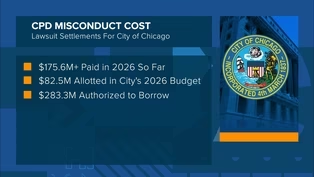
New4 Months Into the Year, Chicago Has Spent at Least $175.6M to Resolve Police Misconduct Lawsuits
Video has Closed Captions
The city’s 2026 budget set aside just $82.5 million for police misconduct settlements. (2m 31s)
 New
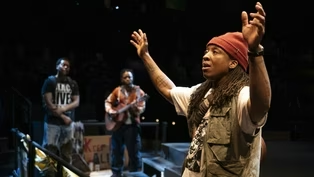
NewOscar-Winning Playwright Tarell Alvin McCraney on New Steppenwolf Play
Video has Closed Captions
“Windfall” was commissioned as part of Steppenwolf Theatre’s 50th anniversary season. (5m 32s)
Providing Support for PBS.org
Learn Moreabout PBS online sponsorship
- News and Public Affairs

Top journalists deliver compelling original analysis of the hour's headlines.

- News and Public Affairs

FRONTLINE is investigative journalism that questions, explains and changes our world.












Support for PBS provided by:
Chicago Tonight is a local public television program presented by WTTW
WTTW video streaming support provided by members and sponsors.