
Egypt’s secret warning to Israel before Oct. 7
Clip: 9/25/2026 | 6m 3sVideo has Closed Captions
Egypt’s secret warning to Israel before Oct. 7
In 2023, Egypt's intelligence chief secretly flew to Israel in the weeks before the Oct. 7 attacks. He delivered a stark warning to Prime Minister Netanyahu's government that Hamas was mobilizing in Gaza for a potential attack. The panel discusses Vivian Salama's report in The Atlantic.
Problems playing video? | Closed Captioning Feedback
Problems playing video? | Closed Captioning Feedback
Major funding for “Washington Week with The Atlantic” is provided by Consumer Cellular, Otsuka, Kaiser Permanente, the Yuen Foundation, and the Corporation for Public Broadcasting.
Egypt’s secret warning to Israel before Oct. 7
Clip: 9/25/2026 | 6m 3sVideo has Closed Captions
In 2023, Egypt's intelligence chief secretly flew to Israel in the weeks before the Oct. 7 attacks. He delivered a stark warning to Prime Minister Netanyahu's government that Hamas was mobilizing in Gaza for a potential attack. The panel discusses Vivian Salama's report in The Atlantic.
Problems playing video? | Closed Captioning Feedback
Where to Watch Washington Week with The Atlantic
Washington Week with The Atlantic is available to stream on pbs.org and the PBS app.
Buy Now

10 big stories Washington Week covered
Washington Week came on the air February 23, 1967. In the 50 years that followed, we covered a lot of history-making events. Read up on 10 of the biggest stories Washington Week covered in its first 50 years.Providing Support for PBS.org
Learn Moreabout PBS online sponsorshipJeffrey Goldberg: Good evening, and welcome to Washington Week.
It's been a busy week here, a state visit from China's president, a new campaign launched by the American president against the media, and more signs that Republicans are distancing themselves from Trump, which might explain why he's so angry at the media, because you have to take out your frustration on someone.
I'll get to all this with my guests tonight, Peter Baker, the chief White House correspondent for The New York Times, Susan Glasser is a staff writer at The New Yorker, Adam Harris co-hosts Radio Atlantic, the flagship Atlantic Magazine podcast, and Vivian Salama is a staff writer at The Atlantic.
Thank you all for joining me.
Vivian, I want to go right to you.
You just broke some big news this afternoon about the Middle East, reporting that the Egyptian intelligence chief secretly flew to Israel in the weeks before the October 7th massacre by Hamas with a stark warning for the Israelis.
Tell us what your reporting found.
Vivian Salama, Staff Writer, The Atlantic: So, in the initial days after October 7th in 2023 there were some reports that the Egyptian intelligence had warned in some way.
Netanyahu's government completely denied those reports, and sort of the world went on.
This year, especially with legislative elections coming up in Israel, I set out to try to understand a little bit more about what we knew in advance of the October 7th attacks.
And one of the key issues, the really startling issues I found, was not only did the Egyptians warned Netanyahu's government, but the intelligence chief actually got on an airplane and traveled to Israel for a total of 67 minutes, to be exact, and conveyed the ominous signs that they were seeing that Gaza could potentially blow.
Jeffrey Goldberg: It wasn't a direct warning the -- Hamas was going to invade the kibbutzim on the border on October 7th.
But it was a warning that things were very unstable.
Vivian Salama: And this was the problem, is that they didn't ha- he didn't have an exact date.
He didn't have the exact way in which Hamas was going to attack, in which we saw on October 7th, this multi-pronged attack.
But he did see, especially through human intelligence or human - - their sources inside the Palestinian Strip -- Jeffrey Goldberg: Well, Egypt shares a border with Gaza.
It presumably has good access.
Vivian Salama: That's right.
They have fantastic access.
In fact, Israel and Egypt, probably in the world, have the most superior intelligence when it comes to Gaza.
Jeffrey Goldberg: Right.
Vivian Salama: And so for Egypt to convey that to Israel, and, of course, they've been intelligence sharing partners since Camp David Accords in 1978.
Jeffrey Goldberg: Right.
Vivian Salama:That was really stark, because as someone who -- as a country who -- that knows Gaza very intimately, they have sources that are embedded with Hamas.
And he said, there is large mobilization for a potential attack.
You need to make some concessions and get ready for it.
Jeffrey Goldberg: Right.
Vivian Salama: And Netanyahu's government dismissed the warnings.
Jeffrey Goldberg:Right.
So, it's interesting that in the Israeli election that's coming up in a month, the number one issue perhaps is this, who's responsible for that -- for allowing that surprise attack.
And there are obviously the people who are running against Netanyahu are calling for a national commission of inquiry to figure this out.
How does this play into the election season?
Vivian Salama: I mean, this is one of the primary drivers that his opponents in particular, one the former IDF staff of -- chief of staff, Gadi Eisenkot, he's been calling for an independent state inquiry as well as a number of other opponents.
Netanyahu's government and his coalition have pushed back on this notion of an independent state inquiry.
They want to kind of handpick the people who are involved.
But, obviously, a very critical issue going into the elections in October.
Jeffrey Goldberg: Peter, it's quite remarkable actually that Israel hasn't had a 9/11-style commission in three years.
And that's at the desk of Netanyahu.
He could allow that to happen if he wanted to.
Peter Baker, Chief White House Correspondent, The New York Times: Yes, he said, We didn't want to do it while we're fighting a war, right?
Let's fight the war first, then we can go back and look at it.
Well, the war is essentially not over, over, but it's not at the stage it was.
Jeffrey Goldberg: Right.
Peter Baker: And he still doesn't want that kind of accountability.
He denied repeatedly that they had warnings in advance, and now we know from Vivian's fantastic reporting that they had the Egyptian intelligence chief, who does not fly there for 67 minutes if he doesn't have something serious to say.
Jeffrey Goldberg: He doesn't go there very often.
Vivian Salama: No, not at all.
Jeffrey Goldberg: That's not a regular -- Peter Baker: And the leader of UAE also, it turns out, called Netanyahu with his own warning.
And my colleagues have some interesting reporting that there had been a suggestion by some security people asking Netanyahu, make some military strikes in Gaza in advance of October 7th.
He said no.
And the reason why was because he thought it would disrupt the possible diplomatic rapprochement with Saudi Arabia that the Biden administration was very, very close to negotiating at the time.
Jeffrey Goldberg: Right.
In which, of course, Hamas sought to disrupt successfully, as it turned out.
Susan, we've been talking about the a prime minister who everybody always counts out, you know, at a certain point who's been prime minister of Israel longer than any person in the country's history.
You've been following this fairly closely.
Obviously there's a lot of -- there's a lot of hope on the part of Democrats and many Republicans actually, including possibly Donald Trump, that Israel gets a new prime minister.
Give us your sense of whether that's actually going to happen or not.
Susan Glasser, Staff Writer, The New Yorker: Yes, well, you're right that certainly it's a bipartisan phenomenon, frustration in Washington with Netanyahu.
President -- Jeffrey Goldberg: This goes back to President Clinton.
Susan Glasser: Absolutely.
And you know, we wrote a book about Jim Baker, who had the distinction of ordering Netanyahu, then a deputy foreign minister, persona non grata in the U.S.
State Department back when George H.W.
Bush was president.
Jeffrey Goldberg: It's a long history.
Susan Glasser: Yes.
It's a long history.
It's a long history.
Look, you'd be foolish to count him out.
He's been a survivor, and he's shown a willingness to make coalitions with different -- very different groups, in the center, on the far right.
That's how he's been governing with the far right coalition for the last few years.
But I think the time has come when Israel understands it's more isolated than ever on the world stage.
The consequences of the war in Gaza are front of mind, and this question of how Israel became so dangerously insecure, I think that is going to be the major issue in the election coming up.
Jeffrey Goldberg: Right.
Well, we're going to talk about that as the weeks go on.
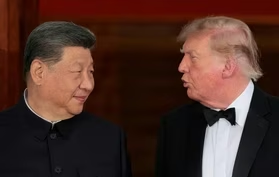
Trump embraces Xi as he turns up attacks on American media
Video has Closed Captions
Trump embraces Xi as he turns up attacks on American media (16m 58s)
Providing Support for PBS.org
Learn Moreabout PBS online sponsorship New Episode
- News and Public Affairs

Top journalists deliver compelling original analysis of the hour's headlines.
 New Episode
- News and Public Affairs

FRONTLINE is investigative journalism that questions, explains and changes our world.
 New Episode
 New Episode
 New Episode
 New Episode


 New Episode


 New Episode
Support for PBS provided by:
Major funding for “Washington Week with The Atlantic” is provided by Consumer Cellular, Otsuka, Kaiser Permanente, the Yuen Foundation, and the Corporation for Public Broadcasting.