Virginia Home Grown
Low-Impact Groundskeeping
Clip: Season 26 Episode 2 | 7m 18sVideo has Closed Captions
Visit a fully electric and organic lawn care company
Dr. Robyn Puffenbarger visits Phillip Rich at Black Roses Landscaping in Charlottesville to learn how his company has adapted to use fully electric lawn maintenance tools. Featured on VHG episode 2602, April 2026.
Problems playing video? | Closed Captioning Feedback
Problems playing video? | Closed Captioning Feedback
Virginia Home Grown is a local public television program presented by VPM
Virginia Home Grown
Low-Impact Groundskeeping
Clip: Season 26 Episode 2 | 7m 18sVideo has Closed Captions
Dr. Robyn Puffenbarger visits Phillip Rich at Black Roses Landscaping in Charlottesville to learn how his company has adapted to use fully electric lawn maintenance tools. Featured on VHG episode 2602, April 2026.
Problems playing video? | Closed Captioning Feedback
How to Watch Virginia Home Grown
Virginia Home Grown is available to stream on pbs.org and the free PBS App, available on iPhone, Apple TV, Android TV, Android smartphones, Amazon Fire TV, Amazon Fire Tablet, Roku, Samsung Smart TV, LG TV, and Vizio.
Providing Support for PBS.org
Learn Moreabout PBS online sponsorship(mower humming) >>Just like a lot of landscapers out there, we've got big riding lawnmowers that are zero turns.
Also the push mowers, edgers, hedge trimmers, chainsaws, just about everything you can think of.
But we have moved to fully electric everything.
So our zero turn is something that is really awesome, very quiet, does the job very well, and yeah, we can do really large properties very fast.
So it has a capacity of about 22 acres, which equates out to be 8 to 10 hours of mow time, just on one charge.
>>Wow, that just sounds so amazing.
I'm used to, with my small push mower, I've got several batteries that I'm gonna have to interchange in and out in order to do what I need to do around my place, and then use a much larger gas mower where I need two sets of ear protection to save my hearing.
And I was just amazed at how quiet the mower was as you were demonstrating how it worked.
>>Yes, yes, and for most homeowners, two batteries with a fast charger will do you with a push mower.
But for larger properties and for us as landscapers, we're, you know, in an attempt to be in and out as much as possible, save our time, and mow things efficiently and quickly.
So that's where we come in.
But for the regular homeowner, two batteries does just fine with a good charger.
Just switch them out as you need, and keep on going.
>>Wow.
So there's just a whole different suite of equipment now available to avoid the use of gas.
I know some neighborhoods are now eliminating... They will not allow you to use a gas leaf blower.
>>That's correct.
There are municipalities that are banning the use of big blowers, and so that's where we come in.
So it's not something that's been around for a while, but the technology has come far, and we're just utilizing it.
>>So besides the electric use with all of your tools, you might be doing some other things differently when you have a homeowner who still wants, you know, some classic lawn areas.
So tell us about the seasonal regime you're using.
>>Especially in the spring, we really try to bring in some good soil that really does well for root establishment.
Really good potassium, and that just really does good things for it.
But a lot of people are using fertilizers.
We try to stick away from that.
And so I try to say, "Hey look, what we can do is overseed, overseed, overseed.
Choke out the weeds with grass instead of the weeds choking out the grass."
And so yeah, that's what we do.
We just try to overseed, and over time, slow is always the better go.
Instead of just trying to use a lot of herbicides, we're on a slope here; it's gonna go right into a waterway.
We realize that everything that we put into the lawn, it's going somewhere.
>>And in terms of doing organic landscaping, what are some of the things that we could do, or we could ask for as homeowners, as we're maybe changing over lawn or spaces into planted beds or edges or wilder areas?
>>So for mulch bed areas, what we use is a double shredded, if not more than double shredded, hardwood bark.
First, the nutrients in hardwood bark are just perfect for most plants, so that's what we use.
But the reason why we're using double shredded or more is that when it rains, it binds, instead of a more thick mulch that when it rains, it can flow away.
The landscaper requirements are two to three inches of mulch.
If you're using enough mulch and something that's good and shredded, binding itself together on top of an organic pre-emergent, oh man, it does the job just great.
>>So I'm not gonna see so many weeds poking out of my beds.
>>Indeed, indeed.
And there's always something organic that's out there.
Certified organic.
Make sure you're using those certified organic products.
There's lots out there.
Just take a look; you'll find it.
>>So for a homeowner like this, they are clearly wanting some grass and then some other areas that are left more natural.
How do you all work within that scope?
>>We're not just landscapers and mowing and blowing and all that, you know, jazz right there.
We're also gardeners.
We take care of hedges, flowers, we're mulching, we're doing just about anything in the yard that some people want to do.
Some people don't.
It just depends on where you need us.
>>It seems like in this neighborhood, there's a lot of flexibility.
The front where you drive by, you've got the classic boxwood hedge, you have the beautiful grandiflora Southern magnolias that are gonna be beautiful in the summer.
And then you come around to this like, secret garden.
So how do you help a homeowner achieve balance, especially if there's an HOA involved?
>>That's a good point to bring up.
HOAs usually don't want to see a whole lot of wilding in the front yard.
But then in the backyard, that's where we really try to bring in some pollinators, some things that are more native that allow for the wildlife to flourish.
>>I was noticing one of your transitions in the front was away from the Asian wisteria, which a lot of people now in the South have learned to fear as it will pull your house down, or your trees down, to another species.
Do you want to talk a little bit about that choice?
>>Yes, the Asian wisteria is very, it's invasive, so we try to stay away from that.
The American wisteria is awesome, very beautiful.
It's something that is just a great accent to a house.
We can structure that, we can train it to go in the way that we want around a trellis, whatever it is, and make it just look really beautiful.
It takes some years to get the right look, but after it's established, it doesn't run off.
(laughs) It stays put.
>>It's a plant I wish more people knew about because I think, classically, people see the Asian wisteria and know in the South it has done some things: pulling down trees, pulling down porches.
It is an overgrowing plant.
>>It'll pull your siding down.
(laughs) >>And I know one of the things I've added in my yard are the buckeyes.
Now mine are all gonna be trees, hopefully eventually.
They're growing very slowly.
This homeowner has buckeyes in a use I had never seen.
>>Mm-hmm, they're a hedge.
So that way, as the homeowners are walking around in their more used property, they can enjoy it.
The wild can be wild.
>>Well, thank you so much, Phillip, for showing us this property and how you're using the electric equipment to maintain the just beautiful area.
>>Well, thank you so much.
Yes, we're doing our best to save the earth as much as we can while at the same time getting the job done as professionally as possible.
 New
NewVideo has Closed Captions
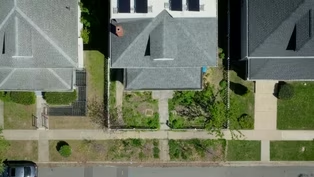
Clip: S26 Ep2 | 7m 58s | Meet a landscaper working to restore energetic potential and abundance in our environment (7m 58s)
 New
NewVideo has Closed Captions
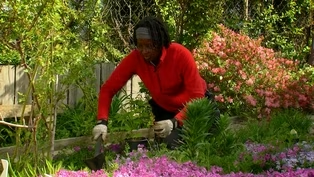
Clip: S26 Ep2 | 3m 6s | Adding more food plants your landscape has many benefits (3m 6s)
 New
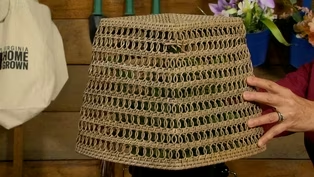
NewPlant Care with Reused and Recycled Containers
Video has Closed Captions
Clip: S26 Ep2 | 5m 57s | Learn about simple items that be reused in your garden (5m 57s)
 New
NewVideo has Closed Captions
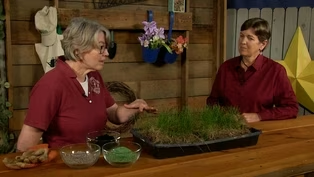
Clip: S26 Ep2 | 6m 9s | Get tips for eco-friendly lawn care (6m 9s)
 New
NewUpcycling Plastic Garden Materials
Video has Closed Captions
Clip: S26 Ep2 | 3m 17s | Give plain plastic nursery pots a new life! (3m 17s)
Providing Support for PBS.org
Learn Moreabout PBS online sponsorship














Support for PBS provided by:
Virginia Home Grown is a local public television program presented by VPM