
How do you prepare for a Shakespearean role?
Clip: Season 54 Episode 5 | 4m 44sVideo has Closed Captions
The cast of Romeo & Juliet reflects on how they prepare for a Shakespearean role.
The cast of Romeo & Juliet reflects on how they prepare for a Shakespearean role.
Problems playing video? | Closed Captioning Feedback
Problems playing video? | Closed Captioning Feedback
Major series funding for GREAT PERFORMANCES is provided by The Joseph & Robert Cornell Memorial Foundation, the Anna-Maria and Stephen Kellen Arts Fund, the LuEsther T. Mertz Charitable Trust, Sue...
Support provided by:

How do you prepare for a Shakespearean role?
Clip: Season 54 Episode 5 | 4m 44sVideo has Closed Captions
The cast of Romeo & Juliet reflects on how they prepare for a Shakespearean role.
Problems playing video? | Closed Captioning Feedback
Where to Watch Great Performances
Great Performances is available to stream on pbs.org and the PBS app.
Buy Now
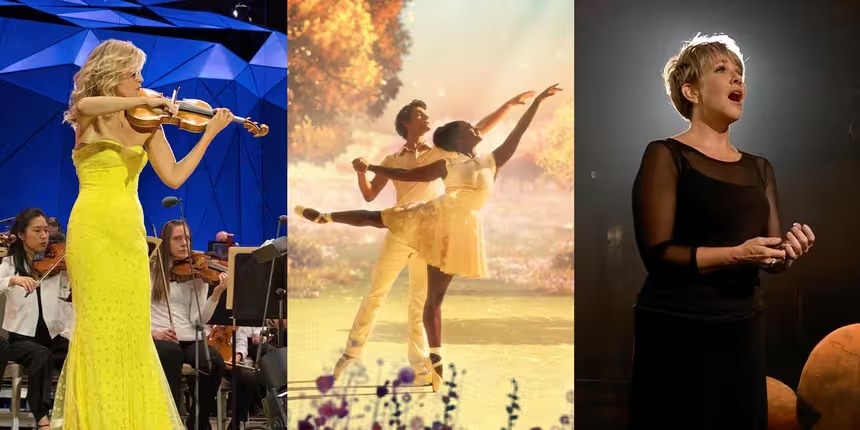
Great Performances Newsletter
Subscribe to the Great Performances newsletter to keep up with the latest full episodes to stream, exclusive content, and more!Providing Support for PBS.org
Learn Moreabout PBS online sponsorshipYou know, I think Shakespeare gives you this really beautiful, pillowy bed with the language.
He tells you who you are.
He tells you where you are.
He tells you when you are, he tells you what you're feeling in all of the language.
Sometimes it's within the meter.
Sometimes it's in the words themselves.
But it it it feels comfortable and homey to me.
And he tells you whether you're self-conscious about your speech.
He tells you whether you're, you know, really, quick witted or slow.
You know, it's, a beautiful place to live in.
Something specific about Shakespeare that I personally enjoy is the puzzle of it all.
So I try and break down absolutely every piece of text, even those that aren't mine, and try and figure out what are the references.
Where do they come from?
Like what year were they made?
What do these words mean?
Like very much.
And I like looking at the translations and then disregarding the translations and then thinking about like as a bilingual person, like there's some words that make more sense in Spanish and that in itself helps me.
So I'm like, what is my innate understanding compared to what Google is telling me it means.
I wrote out all my lines and my scenes, gave them space so I could scan them like, you know, in Shakespeare, there's iambic pentameter, iambic pentameter or blank verse.
And the scansion is how it, how the rhythm fits into the line.
So it's like bum bum bum bum bum bum bum bum bum bum is like a blank verse.
And that adjusts here and there depending on what emotion Shakespeare wants the character to evoke or portray.
And I just like, broke that down technically, because that honestly was the last being that it has been so long since I've done Shakespeare, that is just where my head went.
So I did a lot of technical stuff first, so that when I came into the room, all of that was sort of like in my body, and I could just let go of it and start to figure out the fun part, which is like who Mercutio is, why he's doing what he's doing, what he wants, what he's not getting, how he's going to get, what he wants.
All that.
The first step I found was panic.
I panicked quite a lot.
It's not in my wheelhouse, necessarily.
I've done I did two parts, but a long, long time ago in a faraway land.
So I was really kind of in over my head.
But I just went in and did homeschool, I homeschooled, I did as many, I read as many books as I could.
I watched as many videos as I could of people teaching other people how to do Shakespeare.
I, I watched a lot, a lot of videos of Shakespeare productions.
I was sort of stuck in bed so I couldn't like go out and go to places because I had just had my knees replaced.
So I, I spent a lot of time just watching movies of Shakespeare.
I think the big thing was with Shakespeare is the verse the iambic pentameter, the musicality of the words.
And so I do approach it differently.
And then specifically with this production as a non-native Spanish speaker, and that's such a huge part of it.
That was another musicality that I had to learn for the show.
So I was kind of learning two different languages.
Shakespeare's already heightened above, you know, our regular everyday speak.
And then it felt like Spanish was like even like a level up from that, like even more poetic and more beautiful and heightened.
You prepare for a Shakespearean role, like you prepare for every role: you read the play and line by line, you ask yourself of what is happening in the scene, what is the action?
Who am I?
What do I want in the scene?
What is stopping me from getting what I want?
But with Shakespeare, you have that extra level of poetry that you have to dissect and uncover and and, find the puzzle of it all and how it all fits together.
And Shakespeare is also very special because it is written in a certain meter in a time.
So it also helps you in the clues of what the sentences mean.
What is the point of each phrase?
What is the point of the scene?
I think the process is similar to acting, any role, but the information is different.
Shakespeare embeds his text with so much, so much information to be mined.
So it's really just a process of digging.
I mean, I think of all acting roles that way, kind of.
But, in Shakespeare, it's very specific, process that takes a lot of trial and error.
You have to try things because there's such huge swings, of emotion and intention just within sometimes a few lines.
So that's been kind of the fun part, particularly with the role, like Capulet, who has a lot of mood swings.
 New
Romeo and Juliet Meet on the Balcony
Video has Closed Captions
Clip: S54 Ep5 | 3m 2s | Romeo and Juliet meet at Juliet's balcony at this production from the Public Theater. (3m 2s)
 New
Romeo (Daniel Bravo Hernández) Tells Friar Lawrence (Francis Jue) about Juliet
Video has Closed Captions
Clip: S54 Ep5 | 3m 2s | Romeo tells Friar Lawrence about meeting Juliet and his plan to marry her. (3m 2s)
 New
Video has Closed Captions
Preview: S54 Ep5 | 30s | Experience the Bard's classic from the Public Theater's Free Shakespeare in the Park. (30s)
Providing Support for PBS.org
Learn Moreabout PBS online sponsorship New Episode
- Arts and Music

Innovative musicians from every genre perform live in the longest-running music series.
- Arts and Music
The Best of the Joy of Painting with Bob Ross
A pop icon, Bob Ross offers soothing words of wisdom as he paints captivating landscapes.

 New Episode



 New Episode

 New Episode
 New Episode

Support for PBS provided by:
Major series funding for GREAT PERFORMANCES is provided by The Joseph & Robert Cornell Memorial Foundation, the Anna-Maria and Stephen Kellen Arts Fund, the LuEsther T. Mertz Charitable Trust, Sue...